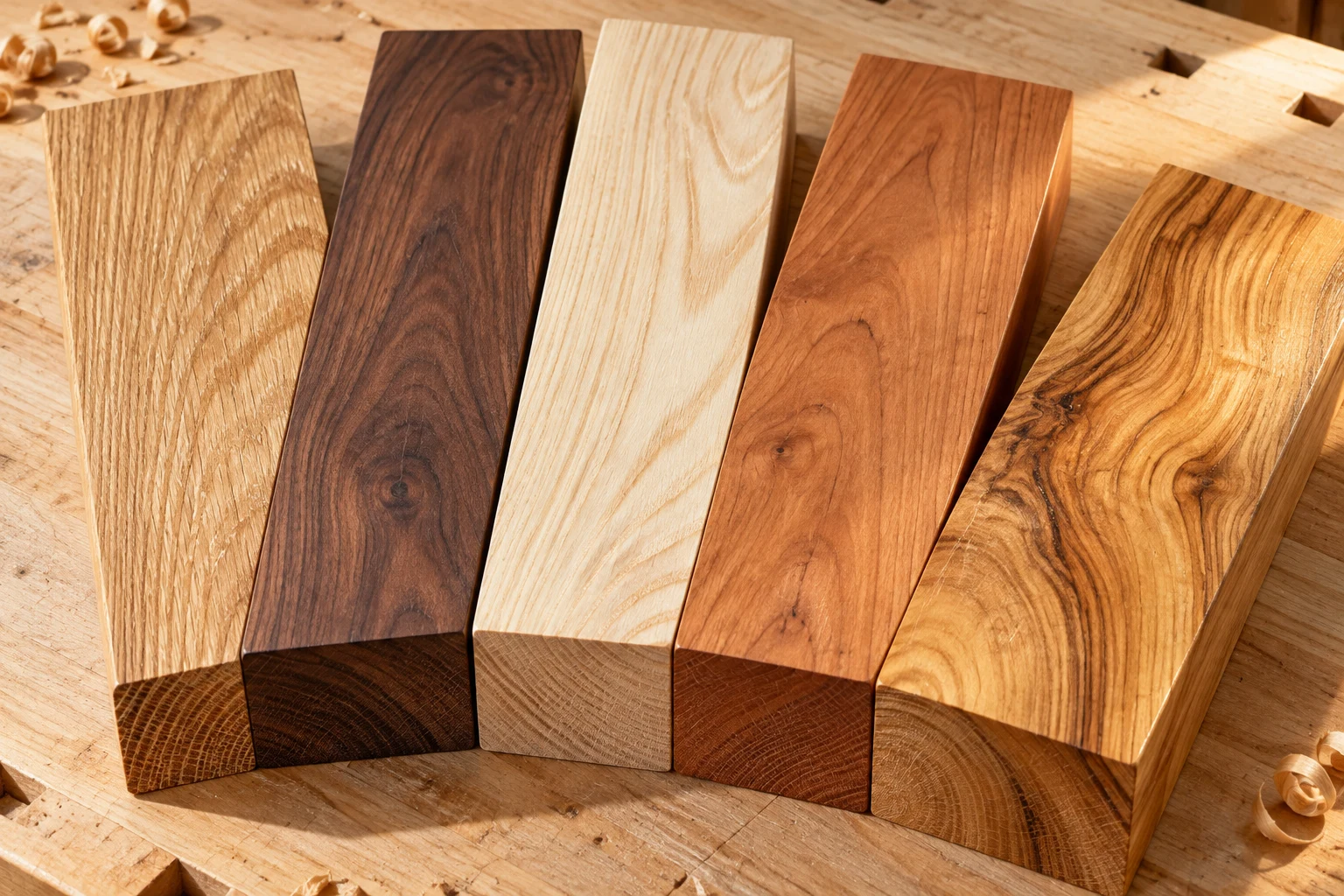
Cherry and elm remain informative studies; they are not choices in this model.
01
Grounded & expressive
Oak
Golden to biscuit brown, with a pronounced grain and visible rays on quarter-sawn faces.
A place for it
Tables, frames and architectural details.
A detail to consider
Open pores remain part of its tactile character. A sample shows whether the finish lifts or quietens that texture.
02
Deep & sculptural
Walnut
Rich brown heartwood with lighter sapwood and a grain that can range from straight to strongly figured.
A place for it
Cabinet fronts, contrasting details and carved forms.
A detail to consider
Colour varies by species and board. Decide early whether pale sapwood is a feature to celebrate.
03
Light & energetic
Ash
A pale timber with an assertive, flowing grain. Its visual rhythm suits generous, simple shapes.
A place for it
Legs, frames and clean contemporary furniture.
A detail to consider
A pale finish is not invisible. Test for warmth and colour change on the actual stock.
04
Warm & evolving
Cherry
A fine-textured timber whose warm tones can deepen with light and time.
A place for it
Smaller cabinets, refined details and turned objects.
A detail to consider
Leave room for natural colour development; avoid expecting a new piece to match an aged sample exactly.
05
Expressive & individual
Elm
Often marked by lively figure and interlocking grain, with generous visual movement.
A place for it
Feature panels and character-led sculptural pieces.
A detail to consider
Interlocked grain can ask more of tools and technique. Let the board guide the form.
Three ways to meet the surface.
Natural oil
A close-to-the-wood feel. Maintenance depends on the specific product and use; test first.
Hardwax oil
A low-sheen option that combines oils and waxes. Follow the system’s own preparation and curing guidance.
Clear lacquer
A film-forming finish with a more sealed feel. Sheen and repair options depend on the product and application.
Wood keeps moving.
Solid timber responds to humidity. Keep furniture away from direct heat, standing water and abrupt changes in conditions. Use coasters, wipe spills promptly with a soft cloth and follow the care guide for the exact finish. Never assume a “natural” coating is food-safe.